
Tilt and Turn Windows have a more complex mechanism compared to Casement Windows or sliding sash windows. The handle engages with different points of the lock and hinges depending on its position, and this allows a dual operation to happen.
This guide explains how tilt and turn mechanisms work, the important components to be aware of and the types of hinges and their function. We also explain the importance of quality, design and material durability for long-term performance.
Click on one of the sections below to learn more:
Understanding Tilt and Turn Window Mechanisms
Tilt and turn windows operate differently to casement windows or sash windows. They offer a dual opening function, allowing for all-weather ventilation by way of tilting or opening fully inwards.
The handle and gearbox shift a continuous rod (drive rod) back and forth around the perimeter of the window frame. As it moves, it engages or disengages cams, locking pins or hinge pins and allowing the tilt or turn function to occur.
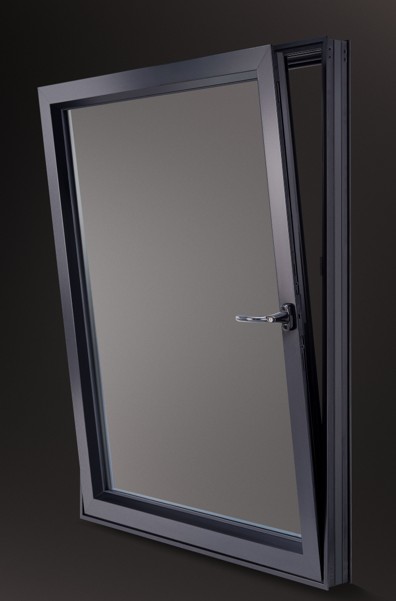
How Tilt Function Operates
When the handle is turned down, the window is securely locked. Turning the handle 90º degrees so it’s horizontal, enables tilt function. Cams and keeps disengage while the bottom pivot point remains connected, allowing the window to tilt open from the top. A stay arm restricts the opening for safe ventilation.
How Turn Function Works
When the turn mode is selected, the handle is turned 180º. Pointing upwards, the locking cams disengage from the keeps and the bottom corner hinge pivots vertically. This allows the window to swing open freely. The majority of the weight is supported by the bottom corner hinge, but the top stay helps establish a vertical pivot axis. In this mode, the stay arm acts as a secondary pivot point instead of restricting the window’s opening.

Components of Tilt and Turn Windows
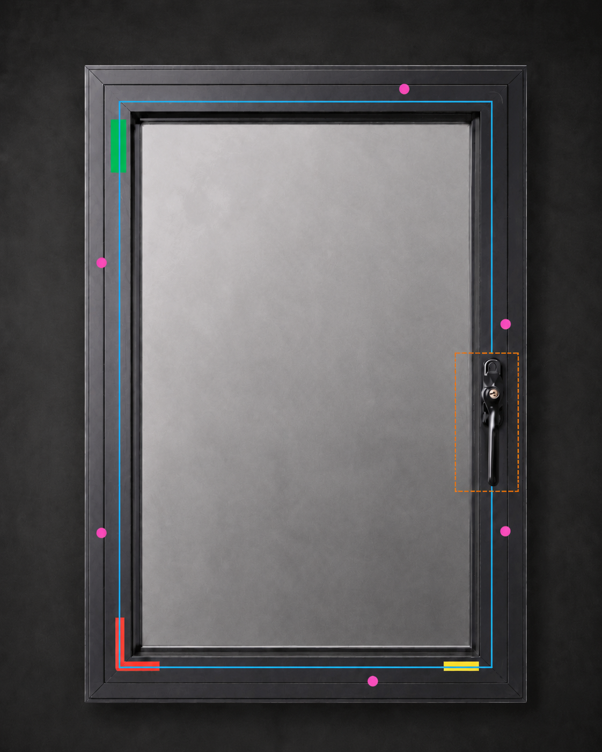
There are many intricate systems and components that make up tilt and turn windows. The key ones to know are detailed below:
● Handle and gearbox (orange): the position of the handle shifts the gearbox, and this facilitates the different opening options.
● Drive rod and corner drives (blue): a continuous rod or metal strip that runs around the perimeter of the opening sash that transfers movement from the gearbox to the locking or pivot points. Corner drives transfer this movement 90º around the frame’s corners.
● Locking cams and frame keeps (pink): cams, rollers or pins are usually attached to the drive rod. These engage with keeps on the outer frame to secure the sash in place when closed.
● Bottom corner hinge (red) : supporting the majority of the weight of the sash, it allows two planes of movement on a vertical or horizontal axis.
● Top stay or stay arm and stay bearing (green) : this is connected to the upper window on the opposite side to the handle and limits how far the window tilts open. It also offers a vertical axis pivot point in turn mode.
● Bottom tilt point (yellow): this keeps the corner located against the frame in the tilt position but disconnects in turn mode, allowing that edge to swing open.
Tilt and Turn Handles Explained
In simple terms, the gearbox turns rotary movement from the handle into linear motion of the drive rod. The handle occupies three different positions. Here, we explain these in more detail:
1. Downwards (0º): the window is securely locked, and the cams and keeps are engaged. This compresses the gaskets to create the most weathertight seal, temperature and sound insulation.
2. Horizontal (90º) : this enables tilt mode. Most of the cams and keeps are disengaged and the bottom pivot point remains connected.
3. Upwards (180º) : this enables turn mode. All cams and keeps are disengaged and the bottom pivot point is released, allowing full inward opening.
We offer two Tilt and Turn Handle options. A rounded handle is available in a variety of finishes including gloss black and chrome. The Gallery handle is only available in the stainless steel finish.


Hinges and Their Role
There are three different types of hinges that are needed to facilitate the dual opening function of tilt and turn windows. These are explained in the table below.
| Hinge type | Pivot axis | Function |
|---|---|---|
Corner hinge | Horizontal or vertical |
|
Stay arm | Vertical |
|
Tilt pivot | Horizontal |
|
The importance of quality hardware for tilt and turn windows
The hardware is more complex than with sash or casement windows, so a meticulous design and durable materials are essential to achieve a seamless operation and longevity. The frame material also makes a significant difference. The corner hinge supports most of the sash's weight, so opting for a lightweight and durable material such as aluminium helps the frames remain aligned, protecting the pivot joints and other moving parts. Hinges are also exposed to the elements, so finding manufacturers with hinge guards and that are made from anti-corrosion materials can extend the lifespan of your windows.
"Material choice matters more in tilt-and-turn windows than in casement windows because the hardware is heavier and more complex. Strong, stable materials such as aluminium provides the structural support needed for smooth operation, larger sizes and heavier glazing. A lower-grade uPVC window can be more prone to movement over time, increasing the risk of the sash dropping, poor alignment and reduced performance.
- Harry Ingram, Head of Research and Development at Origin
Origin’s aluminium systems are engineered to deliver the strength and precision that tilt-and-turn mechanisms demand."
Frequently asked questions:
Can I upgrade my windows with new tilt and turn handles?
It is not possible to upgrade casement windows with tilt and turn hardware because the entire window system is designed to accommodate the dual opening function. However, if there is a problem with your existing tilt and turn hardware, it may be possible to replace it.
Are there security features in modern tilt and turn window handles?
Origin Windows feature secure multi-point locks, lockable handles and crimped frames to prevent tampering and enhance home security. Read more about window security .
What is the difference between handles for tilt and turn windows versus regular window handles?
A tilt-and-turn handle controls several functions rather than simply locking and unlocking the window. Its position operates the gearbox and perimeter hardware to select the closed, tilt or turn mode. A regular casement window handle does not need to coordinate multiple points around the frame.
Do tilt and turn windows break easily?
Well-designed tilt and turn windows should not break easily. Their mechanisms are more complex, so hardware quality, correct installation and high level manufacture are important. Problems are more likely to occur when low-grade components are used, the sash is too heavy for the hardware, the window becomes misaligned or the handle is forced.
